
Costa Rican Visual Artist

JUAN GHA

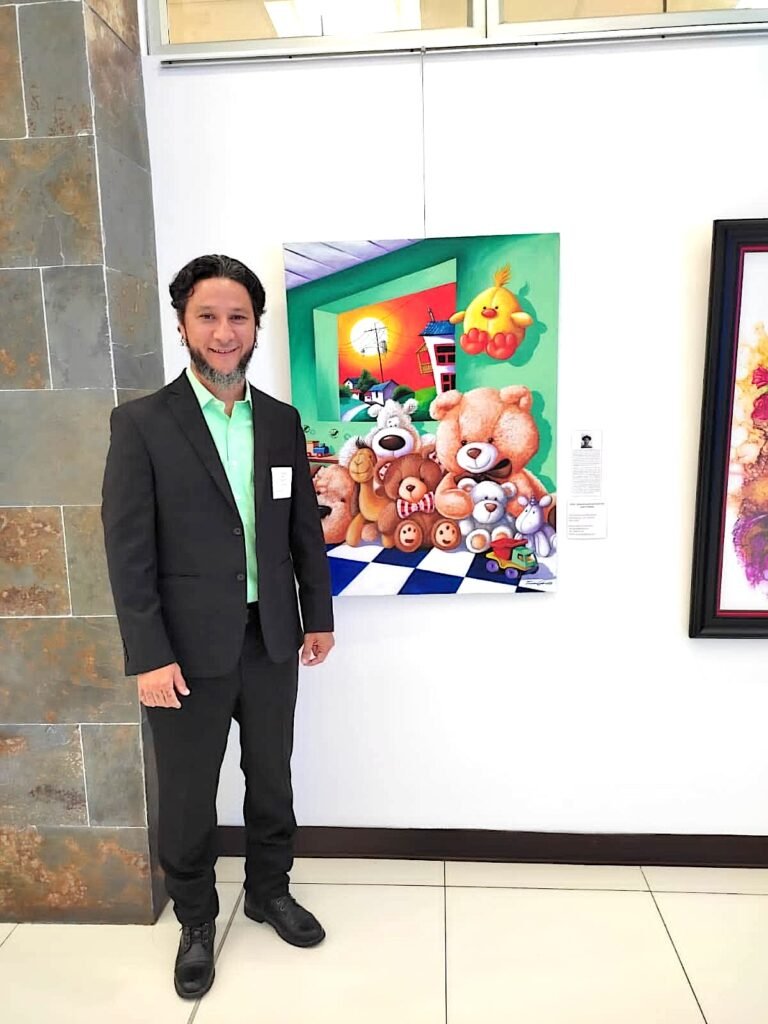
Juan Gha, pioneer of Chromatic Magical Infantilism:“…My oeuvre celebrates childhood as a philosophical territory. Through explosive color, inflated forms, and the integration of three-dimensional mobile eyes, I forge a universe where tenderness is resistance and play is a method of knowledge.
Each painting is an invitation to reclaim the capacity for wonder.

My work enters into dialogue with Fauvism, Naïve Art, and Latin American Magical Realism, yet stems from a singular poetic vision: Chromatic Magical Infantilism, where joy is not naïveté, but a conscious aesthetic act…”
Read more about my style…

Juan gha el cinco creador del infantilismo magico

Artistic Manifesto

Juan Gha’s oeuvre signifies a poetic revolution within Latin American contemporary art: the reclamation of joy as a serious aesthetic act.

Through Chromatic Magical Infantilism, Gha constructs a universe where childhood is not nostalgia, but rather a philosophical territory. His paintings—explosive in color, tender in form—celebrate the human capacity to find wonder in simplicity.

In an artistic landscape dominated by cynicism and ironic detachment, Juan Gha posits a radical alternative: tenderness as cultural resistance, color as a language of healing, and play as a method of knowledge.

Juan Gha’s Visual Signature

Distinctive Elements of Juan Gha’s Visual Signature

Juan gha El Cinco Infantilismo Magico

Structural Color

Explosive palettes that do not decorate—they define. Each work becomes a chromatic symphony where oranges, yellows, and purples engage in an emotionally charged dialogue.

Affective Volumetrics

Inflated, rounded, softened forms.

A geometry of embrace in which every figure feels like a toy awaiting touch.

Juan gha El Cinco Infantilismo Magico

Tropical Identity

Caribbean landscapes, Afro-Latin characters, chocolate-skinned musicians. A cultural celebration devoid of folklorism or exoticism.

Juan gha El Cinco Infantilismo Magico

Dream Logic

It abandons rational perspective in favor of the spatiality of play: crooked houses, undulating hills, cats that take flight.

Distinctive Element:

👀 The Movable Eyes

The insertion of three-dimensional movable eyes transforms each work into a hybrid object between painting and toy. This contemporary gimmick turns the spectator into a co-creator: the work gazes at you, responds to your movement, plays with you. It is a tender irony that celebrates the material culture of childhood without cynicism or distance.

Juan gha El Cinco Infantilismo Magico

Juan Gabriel Morales / Juan gha

Biography

Juan Gha is a Costa Rican visual artist whose work has redefined the boundaries between high art and popular culture, between museum and toy store.

With a solid technique and a profoundly Latin American imaginary, Juan Gha has constructed a visual language that celebrates childhood as a permanent state of consciousness.
His work emerges as a mature, original, and necessary proposal in the contemporary art landscape.

Juan Gha engages in dialogue with multiple traditions:

Context e Influences


Fauvism for its chromatic freedom | Naïve art for its structured ingenuity | Latin American magical realism for naturalizing the fantastic | Pop art for its cultural icons | Postmodern aesthetics for integrating physical objects into painting.
However, his synthesis is unique: a visual poetics that turns play into philosophy and tenderness into a political act.

Press & Media

Immerse yourself in the complete trajectory of the visual artist Juan Gabriel Morales Picado, universally known as Juan Gha or El Cinco. This section is the essential compilation of press notes, television reports, and mentions in specialized magazines that not only document the evolution of his innovative post-Cubist style, Chromatic Magical Infantilism, but also validate his extensive legacy in Costa Rica.

Discover how Juan Gha and his company Arte Corporativo CR have transformed more than 500 spaces across the country, consolidating muralism as a powerful tool for brand building. His work has been highlighted by national media outlets such as Teletica, La Nación and Delfino, confirming his position as a fundamental reference in corporate and muralist art in Costa Rica.

Back to Top

Scroll to Top